Call for abstracts 2022 European School Education Platform – Articles on school education based on action research methodology @eTwinningEurope

Call for papers proposta nell’ambito del progetto „Mediazione per l’accoglienza“ Consorzio Erasmus Plus 2021-1-IT02-KA121-SCH-000012059: Obiettivi: tutti, da 1 a 10.

https://www.schooleducationgateway.eu/downloads/files/CFA2022-actionresearch.pdf


European School Education Platform is a new European Commission platform to be launched in 2022. The platform will offer a new home for the School Education Gateway users and the eTwinning community.

The platform will have a dedicated section encouraging and showcasing particularly research carried out by teacher researchers, early-career researchers, and student teachers.

The selected, peer- reviewed articles from this call will be published in this section.
eTwinning is the community for schools in Europe that has been engaging educators across the continent for over 15 years in collaborative cross-border classroom projects in 44 countries and professional development. Currently it counts over 1 million registered users, over 225.000 schools and over 130.000 projects.
Action research invites teachers to learn more about their classroom practice and enrich their pedagogical competence by reflecting on their work, solving problems and making evidence-based improvements for their own practices and contexts.


Scope of the call for papers: We publish high-quality articles that report empirical findings based on action research methodology from any school- or classroom-based activities, including as part of projects at national or European level (e.g., eTwinning projects).


Topics: All topics within school education are to the call, as long as action research methodology has been applied in your work. However, you need to explain the chosen topic and justify it within the context of the work. If you are in look for inspiration, see the following topics as example:
• Innovative learning space design
• Inclusive education
• Environmental education / learning environments
• Wellbeing at school
• Blended learning (especially in the context of the (post-)pandemic)1
• ICT in education
• Schools in rural areas
• Key competences for lifelong learning.


Levels of education: Research works that cover levels from Early Childhood Education and Care (ECEC) to primary school and lower/upper secondary school, as well as Initial Vocational Education and Training (IVET).

Who can submit? With this call we would like to encourage teachers and student teachers by offering them an opportunity to have their works academically peer-reviewed and published. The call is relevant for all those who have carried or are carrying out action research as part of their teaching or studies and would like to share the results of their research.

The works can be co-authored (i.e., that
a paper has more than one author). The authors should be based in one of the eTwinning participating countries.
Submission and selection process
• Submission: The call for abstracts is open until 31 May 2022 (23:59 CEST). The submission is done through this online form.

All papers need to be submitted in English.
Pier-review
• The submitted abstracts will first be screened
by an internal editorial board.
• The authors of abstracts that comply with the requirements indicated in the submission guidelines will be asked to submit the full paper.
• The full paper will be subject to anonymous double-blind peer-review by two external experts.

Selection: Notification of paper acceptance will be communicated latest by 30 September 2022. The authors of the selected papers will be requested to re-submit a revised version (if needed; taking into account reviewers’ comments) by 30 October.


Publication: The final selection of articles will be published online at the upcoming European Commission’s “European School Education Platform” (open access): the article summary will be published in 29 languages and the full paper in English. The authors will be asked to sign an IPR waiver.


Please see the submission guidelines (for abstracts and full papers) and the general information and conditions further down in this document.
Further information and disclaimer
The editorial team will keep you informed as to your article’s progress throughout the production processes. In case you have questions about the call, you are welcome to contact us at: support@schooleducationgateway.eu


The call is organised by EUN Partnership (known as European Schoolnet) on behalf of the European Commission’s DG Education and Culture, under a contract with the European Education and Culture Executive Agency.


eTwinning and the School Education Gateway platform (and the future European School Education Platform) are initiatives of the European Union and funded by Erasmus+, the European programme for Education, Training, Youth and Sport.

This activity has been prepared for the European Commission; however it reflects the views only of the authors, and the Commission cannot be held responsible for any use which may be made of the information contained therein.

Abstract submission guidelines
Format of the extended abstract
• Language policy: Abstracts will be accepted in English only.
• Word processing formats: the submissions must be prepared in MS Word or OpenOffice.
• File extensions: .docx or .odt are accepted (.pdf is not accepted).
• Length: max. 1000 words excluding references, tables, charts, and figures.
Abstract headings
The abstracts must be structured with the following headings:
• Font size and type: standard fonts (e.g., Times New Roman, Arial, Calibri), font size 11, with 1.5 line spacing.
• File size: max. 1 Mb
• Exclusions: do not include any author data in the abstract document.
Introduction: Approx. 200 words
Literature review: Approx. 300 words
Methodology: Approx. 300 words
Results and discussion: Approx. 200 words

Submission
The deadline for submissions is 31 May 2022 (23:59 CEST). The submission of abstracts must be done through this online form: https://ec.europa.eu/eusurvey/runner/ESEP-AR-call-2022


In case you have questions about the call, you are welcome to contact us at:
support@schooleducationgateway.eu
Digital Education Action Plan (2021-2027) – What is the Digital Education Action Plan? @EUDigitalEdu

Approfondimento formativo nell’ambito del progetto „ Mediazione per l’accoglienza“ Consorzio Erasmus Plus 2021-1-IT02-KA121-SCH-000012059: Obiettivi 7, 8, 9.

The Digital Education Action Plan (2021-2027) is a renewed European Union (EU) policy initiative to support the sustainable and effective adaptation of the education and training systems of EU Member States to the digital age.  

The Digital Education Action Plan

  • offers a long-term strategic vision for high-quality, inclusive and accessible European digital education 
  • addresses the challenges and opportunities of the COVID-19 pandemic, which has led to the unprecedented use of technology for education and training purposes 
  • seeks stronger cooperation at the EU level on digital education and underscores the importance of working together across sectors to bring education into the digital age
  • presents opportunities, including improved quality and quantity of teaching concerning digital technologies, support for the digitalisation of teaching methods and pedagogies and the provision of infrastructure required for inclusive and resilient remote learning

To achieve these objectives, the Action Plan sets out 2 priority areas.

  1. Fostering the development of a high-performing digital education ecosystem

This includes

  • infrastructure, connectivity and digital equipment
  • effective digital capacity planning and development, including up-to-date organisational capabilities
  • digitally competent and confident teachers and education and training staff
  • high-quality learning content, user-friendly tools and secure platforms which respect e-privacy rules and ethical standards
  1. Enhancing digital skills and competences for the digital transformation

This requires

  • basic digital skills and competences from an early age
  • digital literacy, including tackling disinformation
  • computing education
  • good knowledge and understanding of data-intensive technologies, such as artificial intelligence (AI)
  • advanced digital skills, which produce more digital specialists 
  • ensuring that girls and young women are equally represented in digital studies and careers

Why is action needed?

Digital transformation has transformed society and the economy with an ever deepening impact on everyday life. However, until the COVID-19 pandemic, its impact on education and training was much more limited. 

The pandemic has demonstrated that having an education and training system which is fit for the digital age is essential. 

While COVID-19 demonstrated the need for higher levels of digital capacity in education and training, it also led to the amplification of a number of existing challenges and inequalities between those who have access to digital technologies and those who do not, including individuals from disadvantaged backgrounds. 

The pandemic has also revealed a number of challenges for education and training systems related to the digital capacities of education and training institutions, teacher training and overall levels of digital skills and competences. 

The figures speak for themselves

  • a 2018 Organisation for Economic Co-operation and Development (OECD) study found that on average less than 40% of educators across the EU felt ready to use digital technologies in teaching, with divergences between EU Member States  
  • more than one third of 13-14 year olds who participated in the International Computer and Information Literacy Study (ICILS) in 2018 did not possess the most basic proficiency level in digital skills
  • a quarter of low-income households have no access to computers and broadband, with divergences across the EU affected by household income (Eurostat, 2019)

The pandemic has accelerated an existing trend towards online and hybrid learning.

This shift has uncovered new and innovative ways for students and educators to organise their teaching and learning activities and to interact in a more personal and flexible manner online. 

These changes call for a strong and coordinated effort at the EU level to support education and training systems to address the challenges identified and exasperated by the COVID-19 pandemic, while putting forward a long-term vision for the way ahead for European digital education. 

Political context

The need for a new Action Plan, building on the first Digital Education Action Plan(2018-2020) was expressed in the Political Guidelines of European Commission President, President Ursula von der Leyen, in July 2019. 

The renewed Digital Education Action Plan  contributes to the Commission’s priority ‘A Europe fit for the Digital Age’ and to Next Generation EU. It also supports the Recovery and Resilience Facility, which aims to create a greener, more digital and resilient European Union. 

The Digital Education Action Plan is a key enabler to realising the vision of achieving a European Education Area by 2025. It contributes to achieving the goals of the European Skills Agenda, the European Social Pillar Action Plan and the ‘2030 Digital Compass: the European way for the Digital Decade’.

Open public consultation

From July to September 2020, the Commission launched an open public consultation to gather the views and experiences of all citizens, institutions and organisations from the public and private sectors on the impact of COVID-19 on education and training, the related switch to distance and online learning and their vision for the future of digital education in Europe. 

The public consultation highlighted that

  • almost 60% of respondents had not used distance and online learning before the crisis
  • 95% consider that the COVID-19 pandemic marks a turning point for how technology is used in education and training
  • respondents expressed that online learning resources and content need to be more relevant, interactive and easy-to-use and not depend on the financial resources of a town or municipality
  • over 60% felt that they had improved their digital skills during the crisis, with more than 50% of respondents wanting to build upon them

With a total of more than 2,700 responses from 60 countries and 127 position papers submitted, the consultation helped to inform the Commission’s proposal for a renewed Digital Education Action Plan, which was adopted by the College of Commissioners on 30 September 2020.

Digital Education Action Plan actions

The Digital Education Plan puts forward the following actions for the period 2021-2027.

Priority 1: Fostering the development of a high-performing digital education ecosystem

  • Action 1: Strategic Dialogue with Member States on the enabling factors for successful digital education
  • Action 2: Council Recommendation on blended learning approaches for high-quality and inclusive primary and secondary education
  • Action 3: European Digital Education Content Framework
  • Action 4: Connectivity and digital equipment for education
  • Action 5: Digital transformation plans for education and training institutions
  • Action 6: Artificial intelligence and data usage in education and training 

Priority 2: Enhancing digital skills and competences for the digital transformation 

  • Action 7: Common guidelines for teachers and educators to foster digital literacy and tackle disinformation through education and training 
  • Action 8: Update the European Digital Competence Framework to include AI and data-related skills
  • Action 9: European Digital Skills Certificate (EDSC)
  • Action 10: Council recommendation on improving the provision of digital skills in education and training
  • Action 11: Cross-national collection of data on student digital skills and introduce an EU target for student digital competence
  • Action 12: Digital Opportunity Traineeships
  • Action 13: Women’s participation in STEM
  • Digital Education Hub 

The Digital Education Hub

To support both priority areas, the Commission will establish a Digital Education Hub strengthening cooperation and exchange in digital education at the EU level.

First Digital Education Action Plan 

The Digital Education Action Plan (2021-2027) builds on the first Digital Education Action Plan (2018- 2020), which had the following priority areas

  • making better use of digital technology for teaching and learning
  • developing digital competencies and skills
  • improving education through better data analysis and foresight

Get in touch

The Digital Education Action Plan is coordinated by the Directorate-General for Education, Youth, Sport and Culture’s (DG EAC) Digital Education unit. 

To find out more about the Digital Education Action Plan, get in touch with us by email at
EAC-DIGITALEDUCATION@ec.europa.eu.

Follow @EUDigitalEdu on Twitter for the latest news and developments on the Digital Education Action Plan and its actions.

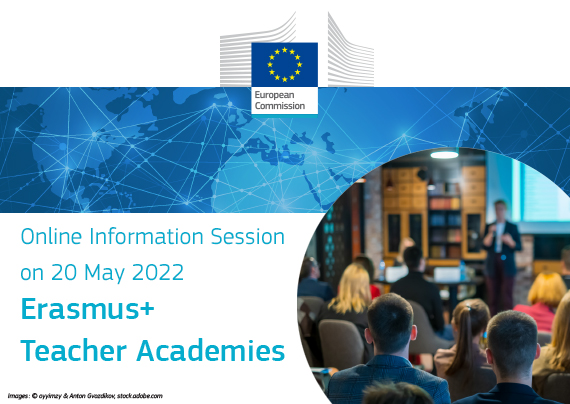
Online Information Session: Erasmus+ Teacher Academies 2022 – Join on 20 May at 14H CEST👇

Seminario proposto nell’ambito del progetto „Mediazione per l’accoglienza“ Consorzio Erasmus Plus 2021-1-IT02-KA121-SCH-000012059: Obiettivo 8

Join this information session on 20 May from 14:00 to 17:00 to know more about Erasmus+ Teacher Academies.

Online Information Session on 20 May 2022, from 14:00 – 17:00, Brussels-Time

The aim of this session is to provide participants with information about the Call for Proposals and give the opportunity to ask questions:

What are Erasmus+ Teacher Academies?

Erasmus+ Teacher Academies promote cooperation between teacher training institutions to improve the quality of initial teacher education. They support teachers in the early years of the profession and through continuous professional development throughout their careers. You can find a list of organisations that can participate and more information on the Teacher Academies Action here.
 

Call for Proposal for Funding Published

A Call for Proposals for Funding was published on 15 March 2022, with a deadline of 7 September 2022. It can be found on the Funding & Tender Opportunities Portal (F&TP).
 

Further Information

  • education grant
  • 20 May 2022, 14:00 CEST – 20 May 2022, 17:00 CEST

Practical information

Friday 20 May 2022, 14:00 CEST – Friday 20 May 2022, 17:00

Event Online Information Session: Erasmus+ Teacher Academies 2022

Welcome

Michèle GrombeerEuropean Education and Culture Executive Agency (EACEA)14:20 – 14:30

Opening

Mariya GabrielEuropean Commission, Commissioner for Innovation, Research, Culture, Education and Youth14:30 – 15:00

Policy context, objectives of the call and expected result

Michael TeutschEuropean Commission, Directorate-General for Education and Culture (DG EAC)15:10 – 15:50

How to prepare a good application & Stats of the 2021 Call Selection

Anders Stjernberg,European Education and Culture Executive Agency (EACEA)15:50 – 16:05

How to find and apply for funding

Róisín Mc CabeEuropean Education and Culture Executive Agency (EACEA)16:05 – 16:20

Budget-based grant agreements

Jehan LarocheEuropean Education and Culture Executive Agency (EACEA) 16:25 – 16:55Questions & Answers16:55 – 17:00

Closing Remarks

Michèle GrombeerEuropean Education and Culture Executive Agency (EACEA)

Arte in tv dal 16 al 22 maggio: i girasoli di Van Gogh, Gauguin e Frida Kahlo

https://www.finestresullarte.info/cinema-teatro-e-tv/programmi-tv-arte-16-22-maggio-2022?utm_source=newsletter&utm_medium=email&utm_campaign=newsletter20220515

Programmi televisivi proposti nell’ambito del progetto „Mediazione per l’accoglienza“ Consorzio Erasmus Plus 2021-1-IT02-KA121-SCH-000012059: Obiettivo 6.

Su Rai Storia le puntate 80, 57, 86, 58 e 4 di #Maestri saranno trasmesse dal lunedì al venerdì alle 17.50). Lunedì 16 maggio alle 21.40 sarà trasmessa una puntata di Italia. Viaggio nella bellezza dal titolo Sulle tracce del patrimonio mondiale (replica venerdì 20 alle 17).

Su Sky Arte lunedì 16 maggio alle 14.30 sarà trasmesso Van Gogh – I Girasoli, seguito da Gauguin: una vita al limite e da MiArt 2022, mentre alle 18.40 torna Dante – Fuga dagli Inferi.

Martedì 17 alle 18.25 torna Frida – Viva la vida.

Giovedì 19 alle 15.50 ci sarà Venezia. Infinita Avanguardia, mentre alle 20.40 ci sarà The Square – Spazio alla cultura, seguito da una maratona di Rinascimenti segreti.

Venerdì 20 alle 15.40 vedremo Le catacombe di Napoli, mentre alle 20.10 torna l’appuntamento con Luce Social Club.

Maratona di programmi culturali su Rai 5 nella giornata di mercoledì 18 maggio: si parte alle 10.22 con Musei, palazzi storici e case di artisti e si prosegue con Museo Italia Firenze, I musei di arte moderna e contemporanea in Italia, una puntata di Italia. Viaggio nella bellezza dal titolo Gli invisibili di Pompei.

Alle 12.22 si alterneranno puntate di Musei, palazzi storici e case di artisti seguita con repliche di Art Night,

alle 15.48 sarà trasmesso I musei di arte moderna e contemporanea, alle 16 sarà la volta della puntata dedicata alla Galleria Borghese di Italia. Viaggio nella bellezza,

mentre alle 17 vedremo il documentario C’era una volta una casa Capodimonte,

alle 19 un’altra puntata di Musei, palazzi storici e case di artisti e alle 19.14 ci sarà Museo Italia Uffizi,

alle 20.07 ci sarà la puntata di Art Night dedicata al Correggio, si prosegue poi con Musei, palazzi storici e case di artisti, Baia, un’altra puntata di Musei, palazzi storici e case di artisti e

alle 22.18 sarà trasmesso Life on Mart.

Venerdì 20 alle 21.15 ci sarà una nuova puntata di Art Night dal titolo Sacro e profano.

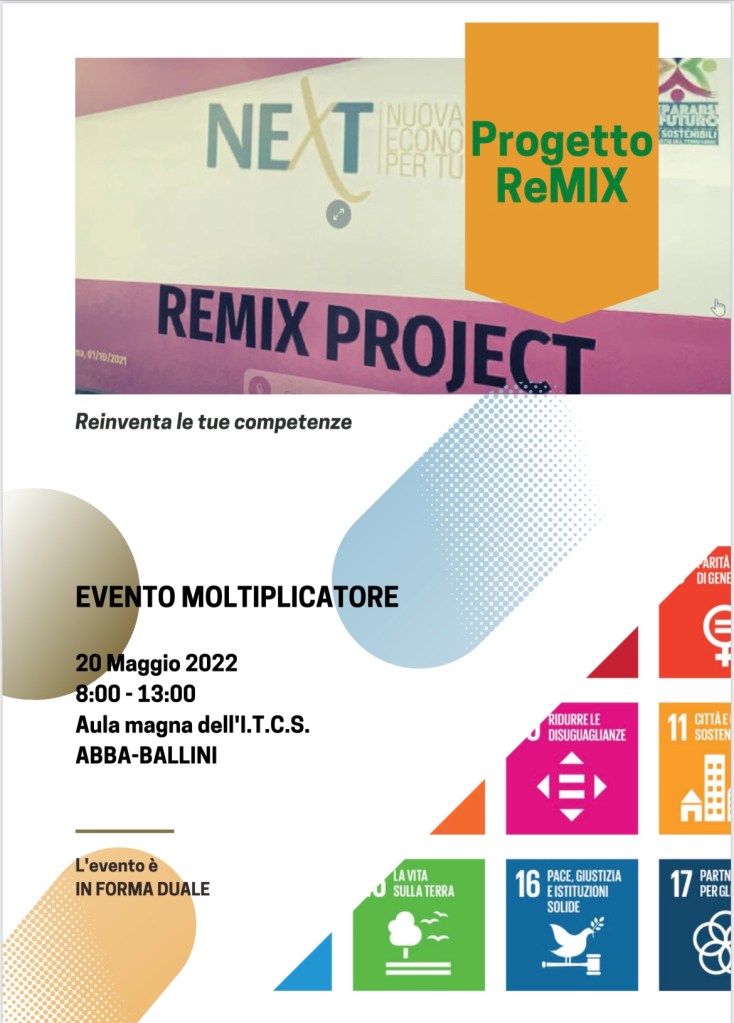
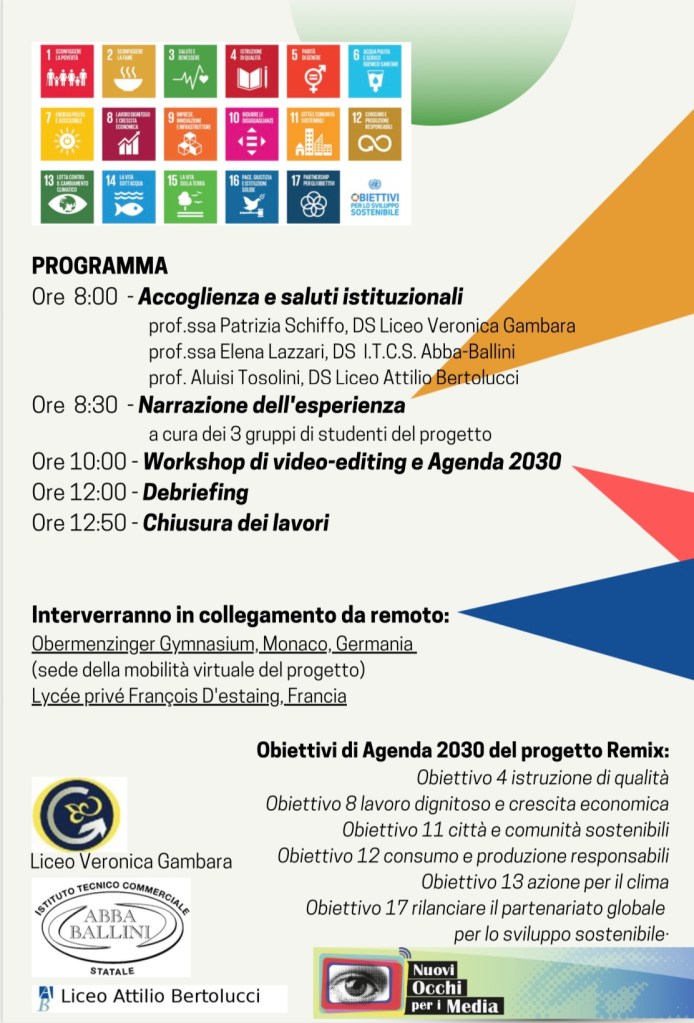
Progetto Remix (Liceo Veronica Gambara, ITCS Abba Bellini e Liceo Attilio Bertolucci): evento moltiplicatore 20.05.2022 ore 8:00-13:00 presso ITCS “Abba/Ballini” Brescia

Progetto proposto nell’ambito del progetto „Mediazione per l’accoglienza“ Consorzio Erasmus Plus 2021-1-IT02-KA121-SCH-000012059: Obiettivi: 3, 5, 7, 9,

Il progetto, ideato da Marzia Vacchelli (Liceo Veronica Gambara, scuola capofila) e da Chiara Medini ( NeXt) in seguito ad Avviso PNSD per la realizzazione di azioni di potenziamento delle competenze degli studenti nell’ambito del Piano Nazionale Scuola Digitale è stato coordinato da Marzia Vacchelli e ha consentito alle studentesse e agli studenti del Liceo Musicale, Linguistico e Scienze Umane Veronica Gambara” (BS), dell’ITCS “Abba-Ballini” (BS), del Liceo “Attilio Bertolucci” di Parma di svolgere le seguenti attività:

Corso di formazione “Linguaggio Audiovisivo, Visione Attiva e Montaggio Video” a cura di Nuovi Occhi per i Media 14/10/2021, – 21/10/21, – 28/10/21, – 11/11/21, 18/11/21, 25/11/21, 2/12/21

Formazione in sincrono relativa a partecipazione e debriefing Festival dell’Economia Civile 24-26/09/2021 a cura di NextNuova economia per tutti 20/9/21 e 27/9/21

Partecipazione a Festival dell’Economia CivileFirenze 24-26 Settembre 2021 con tutoraggio NextNuova economia per tutti

Formazione in sincrono su Agenda 2030, analisi di contesto e BES: strumento italiano di misurazione del benessere dei cittadini a cura di Next- Nuova Economia per tutti 4/10/21, 24/10/21, 29/11/21

Formazione in preparazione Mobilità Virtuale Monaco Liceo Obermenzinger a cura di Next- Nuova Economia per tutti

24/1/22 (2 ore) e 10/2/22 (1 ora) Mobilità virtuale in Peer Education con studenti Liceo Obermenzinger di Monaco (17 e 18/2/22)

Formazione in vista della realizzazione di video finali a cura di ciascun studente per un totale di 3 ore 14/3/22, 27/4/22