The conference, held on 19-21 October 2023, encouraged 700 educators from all across Europe not to be afraid of being innovative and creative. Over three days of discussions, keynotes and exchange of knowledge, attendants collectively explored the multifaced meaning of the eTwinning Annual theme ‘Innovation and Education’.
‘The eTwinning community is as remarkable as it is committed to its mission not just passing knowledge and facts but developing a common spirit for learning together in a community connected across Europe.’
With these inspiring words, Iliana Ivanova, European Commissioner for Innovation, Research, Culture, Education and Youth officially opened the eTwinning Annual Conference 2023. In her message, she congratulated eTwinners for their innovative work and highlighted the importance of the current annual theme by announcing the new eTwinning book: eTwinning; teaching, creating, innovating.
The first keynote featured an enlightening speech by Georgi Dimitrov, Head of Unit Digital Education – European Commission, who discussed the steps taken by the European Commission to contribute to building a shared understanding of digital education and skills in Europe. The speech had a special focus on artificial intelligence and its impact on teaching and learning practices, suggesting how:
‘Balancing AI’s potential benefits with preserving core values and human interactions is essential for effective education.’
Next in line, Stephan Vincent-Lancrin, Senior Analyst, OECD, delivered a second keynote titled ‘Innovation in Education, from theory to practice’ where he explored the multifaceted dimensions of innovation, drawing upon the OECD’s pioneering research in fostering creativity and critical thinking within education.
‘Innovation is not an end; we’re not innovating for the sake of it but because we’re trying to improve something.’
The panel discussion, following the second keynote address, consisted of an interactive discussion with representatives of the prize-winning eTwinning projects of 2023. Participants discovered the core elements that set the winning projects apart and learnt first-hand how they can also run innovative eTwinning projects with their students.
The second day, restricted to registered participants only, kicked off with the launch of the Virtual Exhibition Halland the networking activities. ‘eTwinning Galaxy’ invited participants to embark on a mission within an imaginative galaxy framework. During this distinctive journey, participants were assigned a mission that entailed navigating through various stations within the virtual galaxy. Each of these stations served as a gateway for exploring and diving into specific themes, with a primary focus on two key areas: ‘Innovation and Education’ and ‘Well-being’. The outcomes showed how eTwinners were enthusiast to ‘get out of their comfort zone’ by challenging themselves in creative and innovative activities.
A total of 17 different workshops offered the participants an interactive approach for discussing and learning about key topics revolving around the annual theme, such as AI, virtual reality, cyber-bullying prevention, special needs, STEAM education, tackling disinformation, boosting transversal skills in pupils, critical thinking, well-being and nurturing global citizenship. A workshop for representatives of Ministries of Education also took place, where the discussion was about a more systemic impact of eTwinning and the importance of giving meaning to innovative practices in education.
During the round table with the supportive partners, speakers highlighted the importance of forging stronger collaboration between schools and various stakeholders to create a more supportive and enriched learning environment.
Finally, on the third and last day of the conference, the participants joined the panel discussion entitled ‘Is my school really innovative?’ While introducing some presumptions about innovation and contextualising eTwinning and its role in pedagogical innovation, the discussion invited students to present concrete proposals for innovation and creativity and what they expect from their schools in this regard.
Ulrike Storost, Head of Sector, European Commission, officially closed the conference thanking participants and congratulating the eTwinning community for supporting innovation and creativity among teachers and students across Europe and beyond.
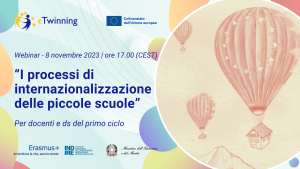
Il prossimo 8 novembre 2023 alle 17 è in programma un nuovo webinar organizzato dall’Unità nazionale eTwinning INDIRE dal titolo “I processi di internazionalizzazione delle Piccole Scuole”, rivolto a docenti e dirigenti di scuole del primo ciclo di istruzione.
Nel corso dell’evento, le insegnanti Lara Fina Ferrari e Vittoria Volterrani condivideranno le esperienze dei loro istituti, parte della rete del progetto di ricerca INDIRE “Piccole Scuole”. Queste, soprattutto grazie ad eTwinning e Erasmus+, hanno avviato un processo virtuoso di internazionalizzazione e innovazione, in particolare attraverso l’innovazione delle pratiche didattiche e l’uso delle tecnologie.
Le esperienze sono raccolte anche all’interno del Report “Playing their part: Small and Rural Schools”, risultato dell’indagine internazionale condotta da INDIRE insieme a European Schoolnet – EUN sulla presenza e il profilo della piccola suola in Europa.
Interverranno le docenti Lara Fina Ferrari, dell’IC del Vergante, Vittoria Volterrani, dell’Istituto Omnicomprensivo di Bobbio (PC) e le Ricercatrici INDIRE Giuseppina Cannella, Giuseppina Rita Jose Mangione e Stefania Chipa.
La partecipazione all’incontro è gratuita previa registrazione entro il 6 novembre, i posti a disposizione vengono assegnati fino ad esaurimento, con priorità ai docenti iscritti a eTwinning. La durata è di circa 2 ore, sarà rilasciato un attestato di partecipazione al termine.
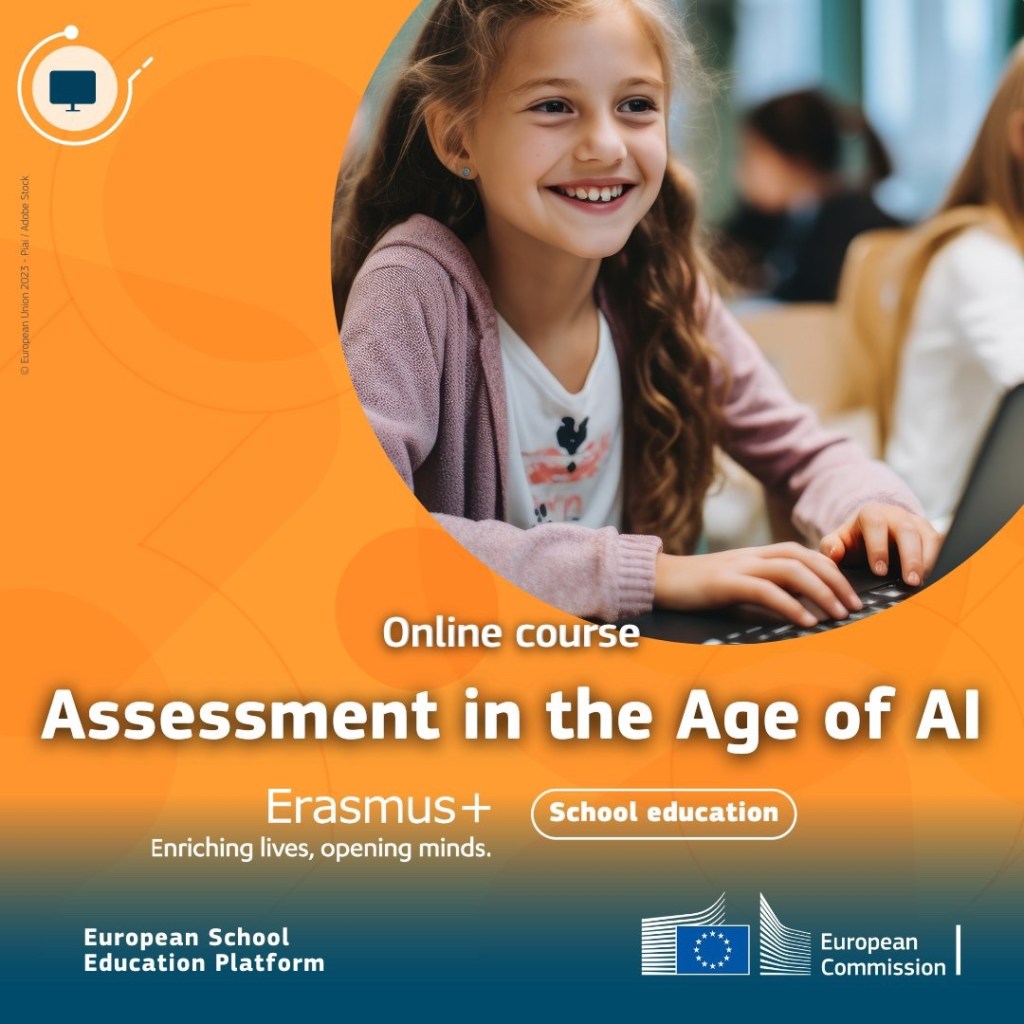
This course recognizes the potential challenges and opportunities that teachers may face with the rise of generative AI and its impact on the development and delivery of student assessments.
The course aims to equip teachers with the necessary knowledge and tools to address these challenges and opportunities. It focuses on tackling issues such as bias and fairness, privacy and data security, automated feedback, validity and reliability of AI-based assessments, interpretation of AI-generated results, and maintaining a positive teacher-student relationship in the context of AI. By providing insights, examples, and discussions, the course empowers teachers to optimize the assessment process, enhance student learning outcomes, and navigate the intersection of assessment and AI in education responsibly and effectively.
Learning objectives
As a participant, you will:
Understand and investigate how to apply formative assessment strategies and tools with the help of AI, by exploring good practices and engaging in discussions with peers.
Understand the opportunities and challenges AI brings to summative assessment strategies and tools and how to address this impact effectively, by exploring a variety of summative assessment practices and discussing these with peers.
Explore ways of integrating artificial intelligence (AI) tools and technologies into your assessment practices to enhance student learning and engagement by participating in interactive activities, practical exercises, and analyzing real-world examples.
Methodology & assessment
The course is offered as an asynchronous course with flexibility in regard to when and where participants follow the course content and join the course activities. Modules open each week and remain open for the duration of the course, with a final deadline in place for the submission of a course product. Participants are required to actively contribute to the course activities by sharing their work and submitting a course product. This product is submitted, and peer assessed by three peers in the final module of the course.
Certification details
Upon successful completion of the course, a digital course certificate is awarded. The certificate shows the name of the learner and key course details such as the estimated learning hours, the learning objectives, and a link to the course homepage.
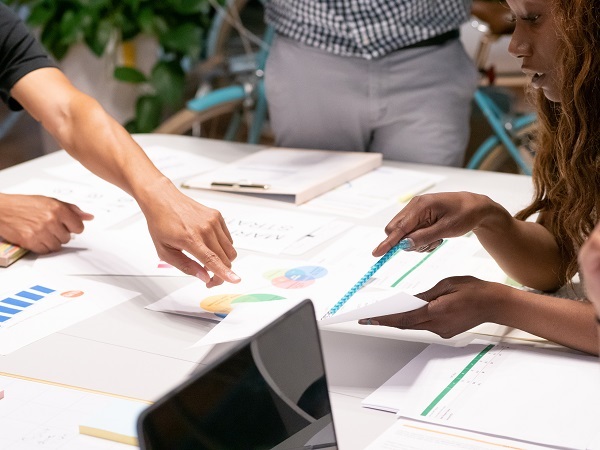
Alternative educational assessment methods focus on the individual needs and growth of each pupil rather than relying on standardised testing, measuring their level of proficiency as opposed to their level of knowledge.
Kindel Media / Pexels
Alternative assessments are designed so that the content of the assessment matches the content of the teaching, and can include open-ended questions, feedback, self-assessment, written compositions, oral presentations, projects, experiments and portfolios of pupil work.
Formative and summative assessment
Different visions of assessment exist; educational literature often refers to two forms of assessment:
Formative assessment, which is ongoing during learning and can be personalised to the pupil’s capabilities and needs,
Summative assessment, which occurs at the end of a learning process and compares the pupil to a set of general standards to define outcomes.
From policy experimentation to practice with Erasmus+ projects
Secondary school teachers spend time on assessment practices, but often use them for summative rather than formative purposes. The Promoting Formative Assessment project argues for an evidence-based and theory-drivenapproach to national policies on assessment. Based on the evidence they gathered, the project developed reusable resources and guidelines on how to use assessment for formative reasons.
The Assess@Learning project addressed assessment and its fitness for purpose in modern digital education systems, competence-based curricula and pedagogies built around enquiry and collaboration. It developed and tested a systemic digital formative assessment (DFA) toolkit on the adoption of DFA practices in schools, and sought to better understand the social impact of DFA on pupils. Involving pupils in the project constitutes a unique part of the policy experimentation.
Assessment for diverse learners and transversal skills
Many educators implement the same routines for all and struggle to adapt their practices to the needs of diverse learners. The Erasmus+ Adaptive Expertise project tackled this outdated form of teaching to support schools, teams and teachers in becoming adaptive experts and developing a policy on adaptive expertise (AE). The project produced an inspirational guide and an online course about acquiring AE through formative assessment.
The Erasmus+ project Futureskills21 supports pupils in acquiring and developing key competences to foster future employability and socio-educational and professional development. It produced Track and Teach, an assessment toolbox for 21st-century competences.
Inclusion and well-being through assessment
Transversal competences, including social and emotional learning, are increasingly considered as key 21st-century skills. These require new assessment methods. The Erasmus+ funded Learning to be project developed a toolkit, a range of resources such as self-assessment tools and policy recommendations for developing social and emotional competences in general education schools. Most materials are available in English, Italian, Spanish, Latvian and Lithuanian.
In Germany, an assessment method called the Kernroutine (core routine) was developed based on international best practice approaches, in particular from a Canadian practice model for the promotion of literacy and numeracy, combining systematic digital learning diagnostics with targeted interventions:
Assess the learning baseline
Analyse the data
Prioritise parental involvement
Plan supportive measures
Formative assessment
The study concludes that if the core routine is implemented, the likelihood that all pupils can achieve the competences needed to engage with the societies in which they live increases significantly.
Integrated assessment in VET
Evaluation and feedback systems in vocational education and training (VET) too often focus only on achieving a standard, not on learning. Therefore, the Erasmus+-funded Meten is Wetenproject’s intention was to adapt and optimise this Belgian VET institution’s way of evaluating and giving feedback. This would be achieved by making its evaluation more digital, and by registering all evaluations and feedback (formative and summative) in a single integrated system.
It analysed usual assessment practices, using the ratio of formative to summative assessment and the time needed for an overview of the student’s learning path. Following this, participants innovated new models of evaluation and feedback based on their experiences.



 Italianistica, Didattica Innovativa, Internazionalizzazione