
Friendship is a language that everyone understands. It transcends cultures and backgrounds.
— Erasmus+ (@EUErasmusPlus) July 30, 2023
Our participants know this well. Thanks to #ErasmusPlus we study abroad, but more importantly: we form lifelong bonds.
Tag your friends & show some love!#InternationalDayOfFriendship pic.twitter.com/EXNDHYJ9PG
eTwinning Webinar: Designing Learning Experiences in Augmented Reality – Artificial Intelligence in education: Does it undermine or support education?
Experts gave a brief introduction into the working principles of Augmented Reality in the classroom and into the methodology for learning experience design (LXD) as well as into an overview on how to use the ARETE authoring toolkit MirageXR:
In a world where AI is growing in importance, it is crucial for education to consider what competencies people need as AI changes how people communicate, work and live with one another and with machines. Against the backdrop of the current public discussions on ChatGPT and its impact on education, the question has come up whether these kinds of technologies are actually supporting or undermining teaching and learning. In this short webinar we want to deal with this essential question by providing context, overview and concrete examples: • Definition: What are we talking about? • AI in education: 5 big ideas? • Use cases of ChatGPT and beyond: Learning with AI, for AI or about AI? • New roles: How does AI impact the role of teachers and students? • Impact: Which benefits and challenges are we facing?
Can we change the story on inclusion in early childhood education?
Stressed, under-resourced and unqualified. Teachers in early childhood education and care (ECEC) across Europe and Central Asia have warned us: large class sizes and lack of confidence, resources and knowledge about supporting children with disabilities or complex needs make it impossible to ensure that all children have the benefit of early learning.
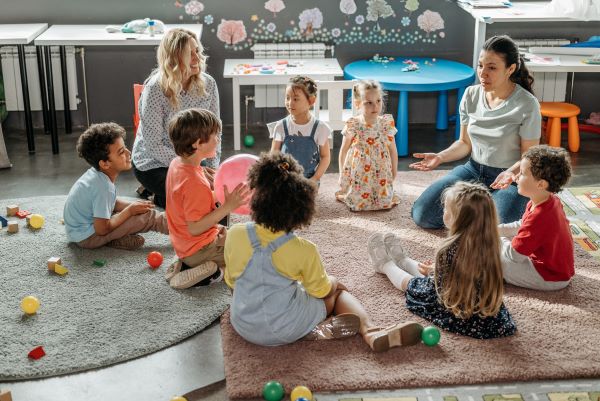
Pavel Danilyuk / Pexels
The TALIS Starting Strong survey found that ECEC teachers experienced high stress related to their working environments and an inability to support the most marginalised children. COVID-19 pandemic restrictions and the associated limitation of children’s social engagement and stimulation have resulted in developmental delays among (and increased the need for intensive individual support for) children, and further exacerbated teacher stress levels.
A study found that half of Bulgaria’s teachers reported low confidence in working with children with disabilities, even when they had received formal training – which is particularly problematic because approximately 5,900 Bulgarian children with specific educational needs are enrolled in kindergartens considered unable to support their needs.
Overcrowded classrooms create stress for young learners and teachers, and prevent educators from providing individualised approaches. Long work hours with little planning time increases pressure on educators, limiting their ability to prepare to manage their learners’ needs. Lack of continuous professional development prevents teachers from building relevant skills, knowledge, innovations in approach and opportunities for peer-to-peer exchange – all of which support inclusive practices.
ECEC teachers have a crucial role to play in meaningful inclusion, but expectations of the ECEC workforce are unrealistic: they are expected to be carers, educators, administrators, parental counsellors, nurses and social workers while also helping young minds thrive. Evidence shows that ECEC settings that foster inclusion and quality of care for the youngest learners also support educators’ confidence in their profession and ability.
Meaningful inclusion involves teams of experts supporting families and children in a ‘one family – one plan’ approach from birth to entry into ECEC, throughout early education and beyond. Services coordinated through the health, education and social welfare sectors have the best chance of improving quality of life for children with disabilities or complex needs, for their families and for the well-being of educators who support them.
This approach has supported children like three-year-old Silvia in Bulgaria to access inclusive ECEC.
For real inclusion in preschool and kindergarten, there must be a support system for educators, to provide them with information, training and reassurance so they can improve their capacities, mental health and well-being. This can be achieved through policies for supportive teaching conditions; strong ECEC management; leadership that fosters collaboration and a culture of care; relevant, quality training and skill-building opportunities; close links with families and communities; and the provision of specialised support that uses the ECEC centre as a base for engaging children and their educators.
UNICEF is working in countries across Europe on the Child Guarantee Phase III programme. This led to the initiation of Together from the Kindergarten in Bulgaria, which introduced inclusive early education via a whole-school approach to strengthen support mechanisms and the environment. A vital part of this work included bolstering the teachers themselves, strengthening their knowledge and capacities, and having specialists support teachers in their daily work. Through this model, educators improve their understanding of children’s needs and can update their practices accordingly. They also benefit from sharing responsibilities, receiving counselling and guidance on complex cases and having more classroom support. This results in improved educator well-being as well as more inclusive practices.
What better way to ensure that we give the best care to our children than by giving the best care to those who look after our children?
Orchestra Erasmus, aperta la call europea rivolta a Conservatori e Istituti musicali per la formazione del nuovo organico – scadenza 18.09.2023
È online una nuova Manifestazione di interesse rivolta a Conservatori e Istituti musicali europei per la formazione dell’organico dell’Orchestra Erasmus, la prima orchestra formata da studenti che abbiano svolto o stiano svolgendo un’esperienza di studio Erasmus.
L’Orchestra Erasmus nasce nel 2017, su iniziativa dell’Agenzia nazionale Erasmus+ INDIRE (Istituto Nazionale di Documentazione Innovazione e Ricerca Educativa) in occasione dei 30 anni del Programma Erasmus.
Si tratta di un progetto pilota per la costruzione di un ensemble artistico itinerante che, grazie al linguaggio universale della musica e dell’arte, possa rappresentare nel mondo il valore di una comune appartenenza europea, che ha come risultato una sinfonia unica.
Da allora, l’Orchestra ha svolto oltre 15 esibizioni in prestigiose location europee e non solo, coinvolgendo più di 20 Conservatori e 200 studenti Erasmus in attività concertistica professionale, fornendo esperienza e collaborazioni di rilevanza internazionale che hanno sottolineato la valenza dell’iniziativa anche a fini formativi.
Il valore dell’Orchestra nel promuovere le opportunità Erasmus+ rivolte al settore AFAM è stato accolto come buona pratica dalla Commissione europea e altri stakeholders e le Agenzie nazionali del Programma.
Questo ha spinto l’Agenzia a strutturate ulteriormente l’iniziativa in una direzione internazionale, lanciando una nuova call di selezione organico non soltanto ai Conservatori e Istituti musicali italiani ma anche a tutti quelli dei Paesi UE ed i Paesi associati al Programma Erasmus+.
L’iniziativa è patrocinata dall’Association Européenne des Conservatoires, Académies de Musique et Musikhochschulen (AEC), che ha sposato il progetto conferendo prestigio, visibilità e promozione a livello europeo.
CLICCA QUI per maggiori informazioni sul progetto Orchestra Erasmus.
Italian Study on impact of eTwinning
The study results were based on a questionnaire that was sent to a sample of 1,034 teachers from various regions in Italy. At the time the survey was sent out, participants had been registered on eTwinning for a minimum of three months and a maximum of 15 years.
The questionnaire and interviews aimed to better understand how participants saw the relationship between eTwinning and the development of their skills in three key areas: Didactics, Teacher Professionalism and School Participation.
Within the subtopic of Didactics, respondents replied that they believe eTwinning helped improve the scope and implementation of digital skills in the classroom, both for them and their students. Some interviewees said that eTwinning projects specifically were crucial when working with special needs students and/or students with a migrant background.
In the category of Professional Development, a positive correlation was found between the frequency of eTwinning project participation and positive feelings about teachers’ professional development. Respondents particularly mentioned the safety of the platform and the effectiveness of transnational peer-to-peer training inherent to eTwinning.
Are you interested in finding out more about the impact of eTwinning on School Participation? You can read the full report for free in English, as well as the summary.
 Italianistica, Didattica Innovativa, Internazionalizzazione