
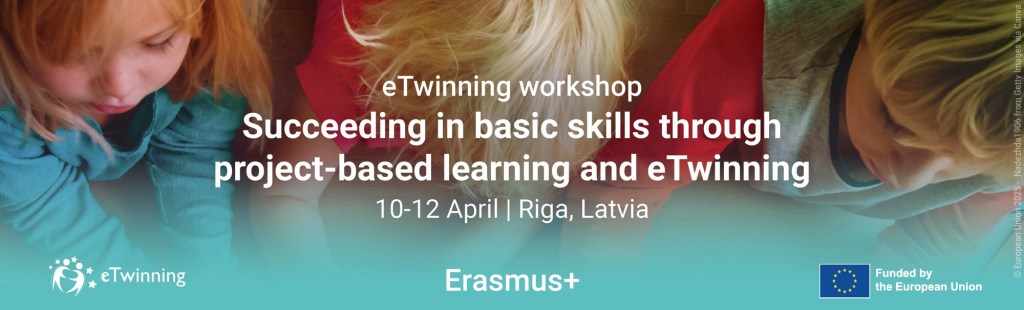
In today’s fast-evolving educational landscape, equipping students with strong basic skills—such as literacy, numeracy, digital competence, and critical thinking—is essential for their academic and personal growth (European Skills Agenda, 2016). Project-based learning (PBL) is an innovative approach that empowers students to acquire these skills by actively engaging in real-world challenges and collaborative projects.
The eTwinning initiative enhances this methodology by fostering cross-border partnerships, enabling students to collaborate with peers across Europe while building key competencies for the 21st century.
This onsite workshop is designed to support early childhood and primary education teachers integrate PBL and eTwinning into their teaching practices. It will provide participants with the knowledge, tools, and strategies to design engaging projects that develop students’ foundational skills and promote cultural exchange.
Some background
Basic skills are the building blocks of lifelong learning and active citizenship, forming the foundation for advanced learning and employment (European Commission, 2024). According to the European Commission, fostering basic skills requires innovative pedagogical approaches that connect classroom learning with real-life applications, ensuring a high-quality education, targeted towards success. Ensuring the provision of high-quality early childhood education and care is, therefore, also an efficient and effective investment in education and training (European Commission, 2024). Project-based learning (PBL) has emerged as a proven method for achieving this, as it engages students in active problem-solving, teamwork, and hands-on activities.
eTwinning, as part of the Erasmus+ programme, provides a dynamic place for teachers and students to collaborate on projects across Europe. By integrating eTwinning with project-based learning, teachers can enhance their students’ basic skills while promoting digital literacy, creativity, and cultural understanding. Students work collaboratively with one another to share ideas, build understanding and complete projects. Teachers discuss, share best practices and look for inspiration from other teachers. Students and teachers work with external stakeholders to make learning relevant and authentic. Learning comes alive. These combinations not only align with European educational goals but also empower students to thrive in an interconnected world.
Purpose of the Workshop
Recognising the vital role that schools play in equipping young minds with essential skills and fostering a positive culture towards learning, this workshop is designed to provide early childhood and primary education teachers with the knowledge, strategies, and resources needed to effectively introduce and implement project-based learning in their classrooms. By empowering teachers to promote collaboration, critical thinking, and creativity, we aim to cultivate a generation of curious, skilled, and engaged learners who are prepared to thrive in an ever-evolving world.
Objectives of the Workshop
- Understand the principles and benefits of project-based learning for developing basic skills.
- Learn practical strategies for integrating project-based learning and eTwinning into classroom practice.
- Design innovative eTwinning projects focused on improving literacy, numeracy, and digital competence.
- Build a network of educators committed to using project-based learning and eTwinning to foster key skills in students.
Join us on 10 April at 14:00 EEST and click here to watch the live sessions of this eTwinning workshop.
https://school-education.ec.europa.eu/en/discover
eTwinning is an initiative of the European Union and funded by Erasmus+, the EU’s programme to support education, training, youth and sport in Europe. This event and related materials have been prepared for the European Commission by European Schoolnet under a contract with the Union, however it reflects the views only of the authors, and the Commission cannot be held responsible for any use which may be made of the information contained therein.


Scopri di più da Italianistica, Didattica Innovativa, Internazionalizzazione
Abbonati per ricevere gli ultimi articoli inviati alla tua e-mail.
 Italianistica, Didattica Innovativa, Internazionalizzazione