

A new UNESCO global survey found that nearly two-thirds of higher education institutions hosting a UNESCO Chair or UNITWIN Network either already have guidance on the use of artificial intelligence or are in the process of developing it.
Summary
This rise in institutional guidance comes as universities worldwide grapple with the opportunities and risks of integrating artificial intelligence (AI) into teaching, research and academic life.
The survey was released during UNESCO’s Digital Learning Week (2-5 September 2025), an event dedicated to exploring the role of AI in shaping the future of education.
Widespread use, uneven confidence
The survey received 400 responses from UNESCO Chairs and UNITWIN Networksacross 90 countries, offering diverse perspectives of how AI integration is emerging in higher education institutions. Nine in ten respondents reported using AI tools in their professional work, most commonly for research and writing tasks. Nearly half are also experimenting with AI in teaching, including lesson planning, grading support, and plagiarism detection, while others use it for administrative or professional development purposes.
Yet, despite high levels of use, confidence remains uneven. Over half feel uncertain or hesitant about its effective pedagogical or research application, have little to no understanding about its technological aspects, or the broader implications on human rights, democracy and social justice. Among those who use AI infrequently or not at all, barriers include ethical and environmental concerns, limited understanding or lack of access, disciplinary constraints, and philosophical resistance to AI’s role in academic work.
One in four respondents reported that their universities had already encountered ethical issues linked to AI, ranging from student overreliance on AI tools to authorship disputes and bias in research. Interviews with a purposeful sample of 10 respondents highlighted concerns with blind AI adoption.
Growing institutional policy frameworks on AI, and investment in AI tools
The survey highlights a clear upward trend in institutional measures addressing the concerns, challenges and demands associated with the use of AI tools (See previous UNESCO article). 19% of respondents indicated that their institutions already have a formal AI policy, while a further 42% reported that AI guiding frameworks are under development. This trend is seen across both public and private institutions, though with regional variation: around 70% of institutions in Europe and North America have or are developing guidance, compared to 45% in Latin America and the Caribbean.
Among institutions with policies in place, implementation measures include awareness campaigns for students, publication of guidelines, and integration of AI rules into academic processes.
The interviews revealed contrasting approaches to AI framework adoption at institutional level: Some higher education institutions adopt a regulatory approach that focuses attention on detecting AI use and managing the consequences of use that are considered to be unethical. Others take an iterative emergent approach that involves systematic consultation and engagement with students and faculty, the introduction of AI literacy as a mandatory course for first year students and embarking on a process of redesigning the university’s assessment system.
The survey also found substantial investment in AI tools. About half reported awareness of institutional spending on AI tools, with two-thirds noting that these investments focus primarily on research. The majority also highlighted investments in AI tools for teaching and student learning, pointing to a recognition of AI’s potential in advancing both knowledge production and education delivery.
Together, these findings underline the urgent need for clear, actionable frameworks and institutional capacity to ensure ethical and human-centred use of AI in higher education.
UNESCO guidance on AI
Over the past years, UNESCO has been working to help educational institutions and countries steer the educational use of AI in humanistic directions that prioritize inclusion, equity, diversity, and quality. The 2021 UNESCO Recommendation on the Ethics of AI provides general principles to anchor sector- and country-specific rules and regulations. The 2021 publication AI and education: Guidance for policy-makers offers pointed policy advice. Most recently, UNESCO published the AI competency framework for students (2024) and the AI competency framework for teachers (2024) to help education systems keep pace with the rapid advances in AI. Currently, guidance on a competency framework for students and faculty in higher education is under way.
About this survey
The survey was conducted among UNESCO Chairs and UNITWIN Networks as part of UNESCO’s ongoing exploration of AI in higher education. With a 38% response rate and a well-balanced regional sample, the results reflect the diverse perspectives of higher education institutions across all world regions and academic disciplines [Arab States (8%), Asia and the Pacific (15%), Europe and North America (47%), Latin America and the Caribbean (20%), Sub-Saharan Africa (10%)]. Follow-up interviews with selected respondents have also been carried out to complement these findings.
UNESCO’s Digital Learning Week
UNESCO Chairs and UNITWIN Networks
Artificial intelligence in education
Publication
AI and the future of education. Disruptions, dilemmas and directions
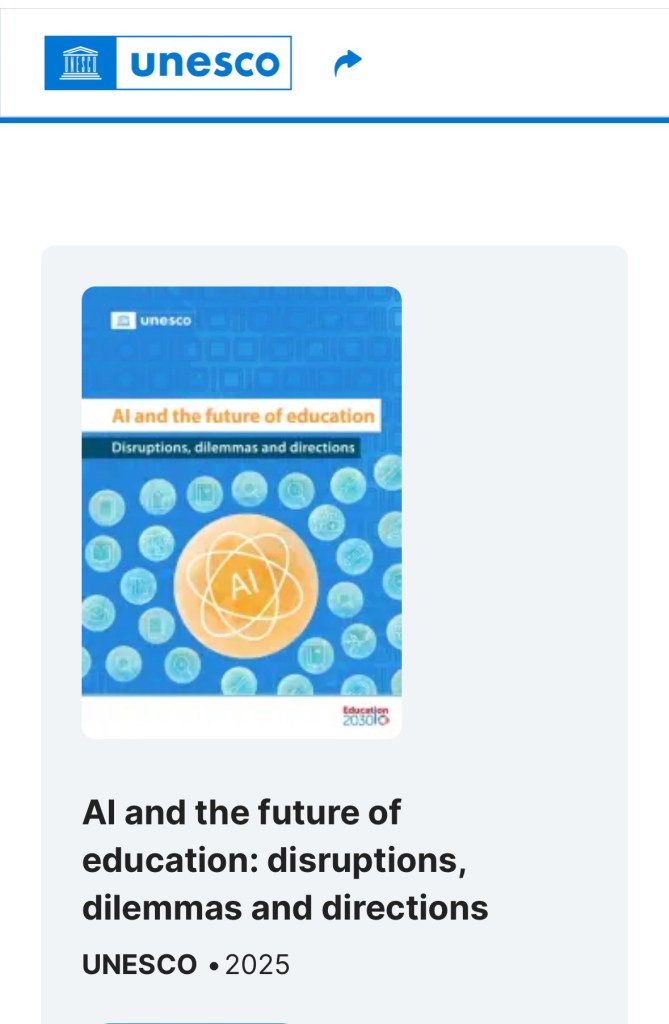
This anthology explores the philosophical, ethical and pedagogical dilemmas posed by disruptive influence of AI in education. Bringing together insights from global thinkers, leaders and changemakers, the collection challenges assumptions, surfaces frictions, provokes contestation, and sparks audacious new visions for equitable human-machine co-creation.
AI and the future of education: disruptions, dilemmas and directions
Artificial intelligence (AI) is reshaping the way we learn, teach and make sense of the world around us – but it is doing so unequally. While one-third of humanity remains offline, access to the most cutting-edge AI models is reserved for those with subscriptions, infrastructure and linguistic advantage.
These disparities not only restrict who can use AI, but also determine which knowledge, values and languages dominate the systems that increasingly influence education.
This anthology explores the philosophical, ethical and pedagogical dilemmas posed by disruptive influence of AI in education. Bringing together insights from global thinkers, leaders and changemakers, the collection challenges assumptions, surfaces frictions, provokes contestation, and sparks audacious new visions for equitable human-machine co-creation.
Covering themes from dismantling outdated assessment systems to cultivating an ethics of care, the 21 think pieces in this volume take a step towards building a global commons for dialogue – a shared space to think together, debate across differences, and reimagine inclusive education in the age of AI.

© UNESCO
Building on UNESCO’s Recommendation on the Ethics of AI, its Guidance on Generative AI in Education and Research and its twin AI competency frameworks for teachers and students, such a global commons can direct collective sense-making and bold reimagination around curricula, pedagogy, governance and policy with human rights, justice and inclusion at its core.
Digital Learning Week 2025. AI and the future of education: Disruptions, dilemm…
UNESCO’s work on artificial intelligence in education
Scopri di più da Italianistica, Didattica Innovativa, Internazionalizzazione
Abbonati per ricevere gli ultimi articoli inviati alla tua e-mail.
 Italianistica, Didattica Innovativa, Internazionalizzazione